One of the country's largest baseball stadiums created its system through partnerships, strong operational design, and an emphasis on compostable packaging.
Every game or event at a major league stadium leaves behind thousands of pounds of food scraps and foodservice items (think: cups, trays, utensils). If those materials aren’t recovered correctly, they end up in a landfill to generate methane—one of the most potent greenhouse gases—and its valuable organic material is lost instead of being returned to the soil.
For stadiums pursuing zero-waste goals, convincing fans to participate in composting isn’t the problem. The challenge is designing a waste diversion system that can keep pace with the realities of live-event venues. Tens of thousands of fans generate waste in just a few hours, vendors operate simultaneously, and every collection decision must be made quickly and correctly to keep compostable materials out of landfills.
In 2016, California passed SB 1383, establishing ambitious statewide targets to divert organic waste from landfill and reduce methane emissions. For large venues like Petco Park, meeting those goals meant rethinking how all the sauce cups and packets, parchment paper, and nacho trays were managed. The sustainability team at Petco Park set out to build an integrated recovery system with Republic Services to make food scrap and foodservice waste recovery possible at stadium scale.
This system demonstrates that with the right operational model, partnerships, and infrastructure in place, large venues can successfully recover food scraps at scale and move closer to a truly circular system.
Most commercial composting programs operate in relatively predictable environments. Stadiums are anything but.
In 2024, the park hosted 85 home games and 98 other events including concerts, community events, and national sporting competitions. That’s at least 3.4 million fans moving through the stadium and generating waste in a single calendar year. And that number doesn’t account for the vendors and on-site staff also generating waste daily.
Once the final out is recorded at a home game, operations immediately shift from hosting toward cleaning and resetting for the next event.
Combine these conditions and there is little room for error in waste management. If collection systems fail, equipment goes offline, or unexpected contamination increases, thousands of food scraps that could be composted may be sent to landfill.
This is compounded by the guest experience itself. Asking that many fans to make multiple waste-sorting decisions simply isn’t realistic. Every sorting decision increases the chance of more waste ending up in landfills.
For Petco Park, success meant designing a system where the easiest choice was also the correct one instead of requiring perfection from every guest. Over the 2025 season, the park was able to increase diversion rates from 44% over the first homestand to a consistent 82% by the end of the season.

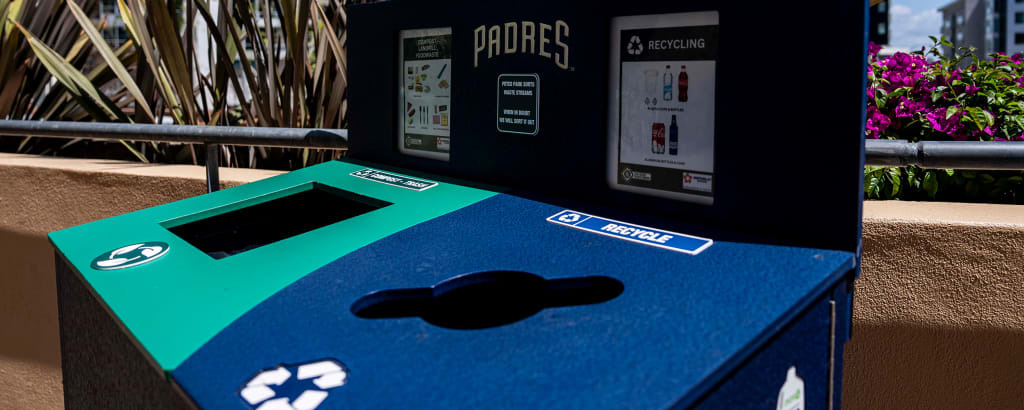
Building a fully operational waste management system is never easy, but adding composting makes things much more challenging. Petco Park knew that any waste hauler would need to become an extension of their team to design a completely new waste management system. They turned to the industry experts: Republic Services to help.
Together, the organizations mapped the entire recovery process. They collaborated on collection infrastructure, front-of-house and back-of-house recovery pathways, acceptable packaging materials, and ongoing operational procedures that could withstand the demands of a live-event environment. Today, Petco park operates a five-compactor system designed to manage the volume of waste generated during games and events. With dedicated compactors for back-of-house food scraps and front-of-house compostables and food scraps, the stadium has the infrastructure needed to recover organic materials efficiently at scale.
And collaboration continued well beyond implementation.
Unlike traditional waste programs that often review diversion performance through monthly reports, Republic provides Petco Park with daily diversion and contamination reporting. That level of visibility allows the stadium’s sustainability team to identify trends immediately, determine where contamination is occurring, and make adjustments before the next event. The speed at which these adjustments can be implemented saves contamination from piling up, keeps the amount sent to landfills low, and ensures the Padres are sprinting as fast as they can toward their zero-waste goals.
Republic is as dedicated to the Padres goals as they are. If a compactor goes offline unexpectedly, Republic is available around-the-clock to resolve the issue immediately. This minimizes disruptions and keeps materials flowing through the appropriate recovery streams.
The organizations meet regularly to evaluate new products, review contamination trends, test materials under real operating conditions, and identify opportunities to improve the system over time. The program’s success has also generated broader organization engagement from Petco Park. Sustainability has evolved from a niche initiative into a visible operational priority supported across departments, creating momentum for continued innovation.

What enters the venue can matter just as much as how material leaves it. Stadiums offer a rare level of control over the products and packaging allowed on-site, giving operators a stronger ability to shape the waste stream before anything reaches a bin.
The best-designed recovery system also matches real guest behavior. If guests are expected to separate leftover food from trays, utensils, cups and other packaging before disposing of them correctly, recovery rates decline quickly.
The Padres addressed this challenge by transitioning foodservice items to compostable alternatives, so that guests had one less decision to make. Simplifying the waste streams means less sorting because approved compostable foodservice items can be placed into designated compost collection bins together with food scraps.
For venue operators, Biodegradable Products Institute-certified compostable packaging can provide an added layer of confidence for identifying products intended for commercial composting when making inventory purchases. For guests, it makes sorting a no-brainer.
As certified compostable packaging evolves and new products enter the market, the Padres and Republic, evaluate new materials alongside hospitality and facility management partners Aramark and Delaware North. Republic helps test the new product under their specific operating conditions before integrating them into the program, boosting their confidence even more.
Certified compostable packaging replaces thousands of pounds of conventional packaging that would otherwise go to the landfill. It acts as a practical tool that, when paired with the right ingredients, helps make successful food scrap recovery at stadium scale possible.
Most composting programs end once materials leave the property, but for Petco Park, that’s only the halfway point.
Food scraps and compostable foodservice items collected throughout the stadium are transported by Republic to a commercial composting facility, where they are transformed into nutrient-rich compost.
That compost is then returned for use at the stadium to support planters around the ballpark and Gallagher Square.
In 2025, of the total 2,003 tons of waste diverted from landfill, with 47 tons of food donated to San Diego Rescue Mission and 856 tons of organic and compostable serviceware ending up at Republic’s compost facility — and then back at the stadium again as high-quality, nutrient-rich compost.
This closed-loop approach is one of the program’s most compelling features. It’s a powerful reminder that organic materials are not waste. They are resources when the right recovery system is in place.
The Padres and Republic demonstrate that successful stadium composting is the result of designing an operating model in which every part of the recovery system works together.
The partnership with Republic illustrates what becomes possible when a waste hauler is treated as a collaborator rather than just a vendor. Daily reporting, rapid response, continuous materials testing, and shared planning create a system that can evolve alongside the venue. For Petco Park that has meant that day-to-day operational diversion rates have climbed significantly, with ongoing efforts focused on reaching 90% diversion for routine operations.
The program’s success has also generated national recognition, including MLB’s Green Glove Award, the Green Sports Alliance Play to Zero Waste Champion Award, and the inaugural MLB Diamond Diversion Award, recognizing Petco Park as one of the leaders in waste diversion and sustainable stadium operations.
“Our responsibility as a baseball team goes beyond creating a great experience for fans. We also have a responsibility to the community we call home," said Padres COO Caroline Perry. “We’re proud to show that a major league ballpark can operate more sustainably and hope it encourages other venues to invest more broadly in their own sustainability goals.”
No two venues will build the exact same program. Every stadium has different infrastructure, staffing models and operational realities. But the principles behind Petco Park’s success are widely adaptable.
For venues looking to reduce waste, the first question is: how do we build a system that makes composting easy, reliable, and repeatable?
For a downloadable PDF version of this blog, click here.
Learn more about Petco Park's sustainability awards here: https://www.mlb.com/padres/ballpark/padres-go-green
Learn more about Petco Park's Composting Playbook: https://www.biocycle.net/petco-park-padres-composting-zero-waste/