For years, sustainability leaders have asked the same question: Will consumers actually show up for this?
According to consumer data shared by Suzanne Shelton, Founder and CEO of Shelton Group , the answer has never been clearer—yes.
At the 2025 BPI Summit, Suzanne presented insights drawn from 19 years of national consumer research, surveying “average humans” twice a year on sustainability, packaging, climate change, and environmental responsibility. What stood out most wasn’t uncertainty or fatigue, but alignment. Consumers increasingly value sustainable packaging, want businesses to reflect their values, and are ready to support companies that take responsibility for what happens to products after use.
“At the end of the day, people want what you want,” Suzanne explained. “They want things to return to the earth.”
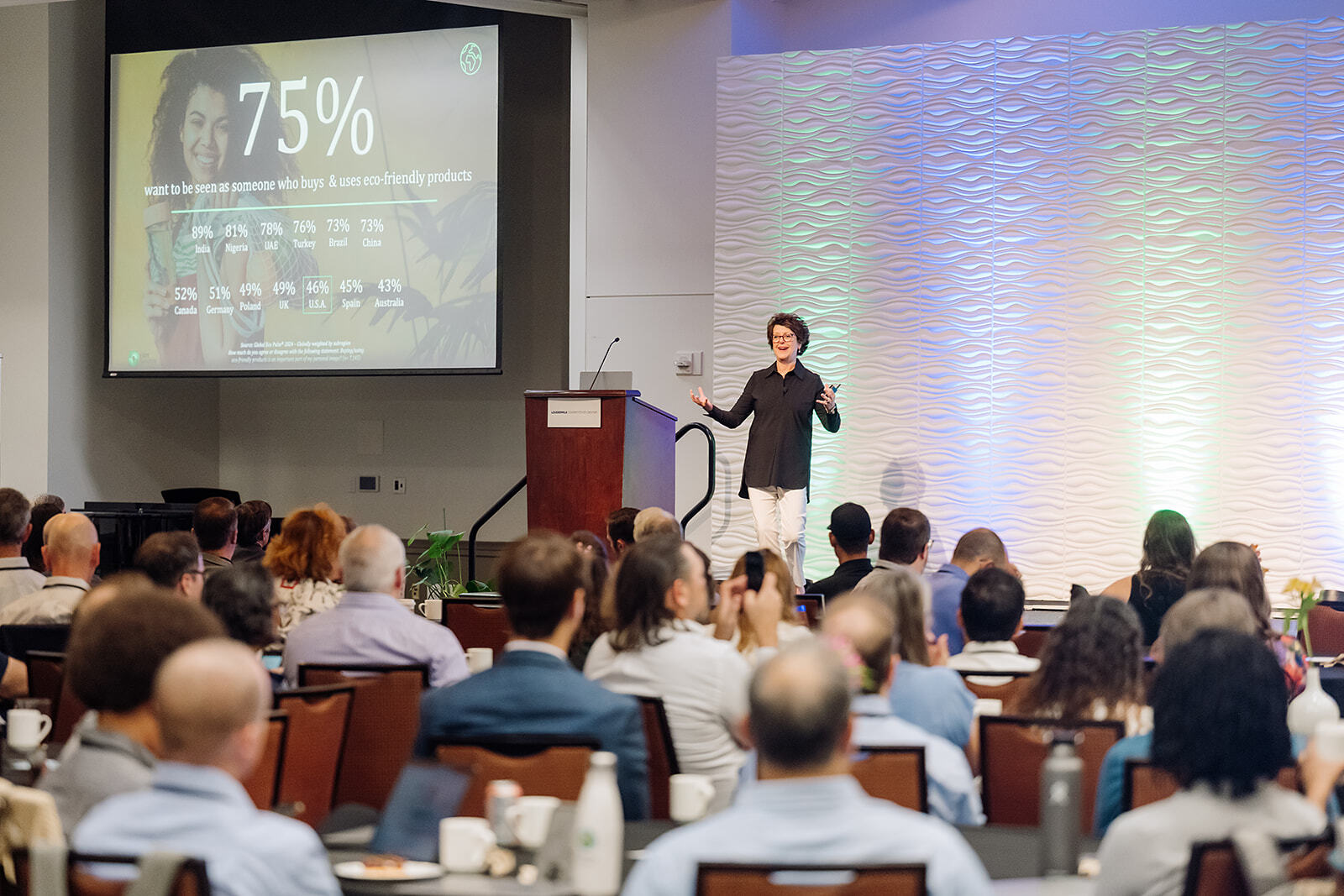
Across nearly two decades of data, Shelton Group consistently sees environmental concern remain high—with packaging waste and end-of-life outcomes among the issues consumers most expect companies to address.
Consumers aren’t just asking what products are made from; they’re asking what happens next. Suzanne’s research shows they actively look for specific, credible signals on packaging — including recyclability, compostability, and third-party certifications they can trust. That expectation places responsibility squarely on brands to solve end-of-life challenges , not shift them onto consumers alone.
Certified compostable products meet that moment by offering a clear, systems-based solution—when paired with the right infrastructure and communication.
Infrastructure is essential, but Suzanne emphasized it’s only part of the equation. Without engagement, even well-designed compostable products won’t deliver impact.
Her data shows consumers want environmentally friendly products —and they want them to return to the earth—but motivation matters. People need to see that composting works, understand their role, and feel confident they’re doing the right thing. Clear labeling, consistent messaging, and education help turn intent into correct disposal behavior.
Engagement bridges the gap between compostable products and compost.
Much of this work happens out of sight. Composters, composting facilities, and certified compostable products quietly make it possible for food scraps and packaging to return to the soil instead of becoming waste.
This reality is highlighted in Hidden Heroes: Plastic Part 2 , Marco Bollinger’s documentary focused on the composters and compostable products that make circular systems function. Suzanne’s data reinforces the same idea: consumers want to do their part—they just don’t always see the systems or people making it possible.
Visibility builds trust. Trust drives participation.
Recent reporting from Spectrum News 1 underscores why alignment matters. In California, organics diversion policies have already delivered measurable climate benefits—with widespread food and organics collection and significant reductions in landfill waste and methane emissions.
At the same time, inconsistent definitions and outdated standards risk confusing consumers and disrupting systems that are working. Suzanne’s data makes clear that consumers are willing to participate—but only when the system around them is coherent.
Suzanne closed her keynote with a lesson drawn from years of coalition work: progress happens faster when organizations move together. Consumers are already aligned around the desire for sustainable packaging and responsible end-of-life solutions. What they need is a system that matches that clarity.
When composters, brands, policymakers, and certification bodies align around shared standards and a consistent message, compostability becomes easier to understand, easier to trust, and easier to participate in. That alignment is what turns consumer intent into everyday behavior—and compostability into real, measurable impact.
Watch Suzanne's full keynote at the Summit below:


