Understanding the meaning and importance behind the BPI Certification Mark
“What’s in a name? That which we call a rose by any other name would smell as sweet.”
— William Shakespeare, Romeo and Juliet
Shakespeare famously questioned the power of names. But in today’s world of sustainability claims and green labels, what something is called—or marked—makes all the difference.
In the world of compostable products, a mark isn’t just a design. It’s a promise—of science, standards, and integrity.
And that’s what the BPI Certification Mark stands for.
The BPI Certification Mark is not a logo for marketing; it’s an official third-party certification symbol. It signifies that a product has been independently tested and verified to meet ASTM standards (D6400 or D6868) for compostability.
When a product carries the BPI Certification Mark, it’s gone through:
In other words: it’s proof, not a pitch.
The mark tells composters, policymakers, and consumers that the product performs as promised—breaking down safely and completely, without leaving behind microplastics or contaminants.
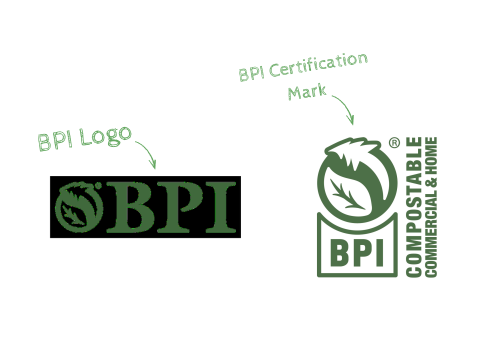
It’s easy to see why people sometimes confuse the two. Both include the letters “BPI,” and both appear on products and packaging. But their functions couldn’t be more different:
To protect the integrity of certification—and to make sure composters and consumers can trust what they see—BPI has clear Certification Mark Usage Guidelines. These outline exactly where and how the mark can appear (for instance, on product packaging or digital materials related to certified products only).
Using the mark correctly reinforces trust. Using it incorrectly risks confusion—and in a world where misinformation spreads quickly, clarity matters more than ever.
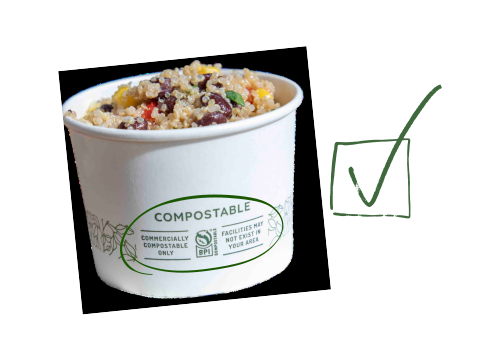
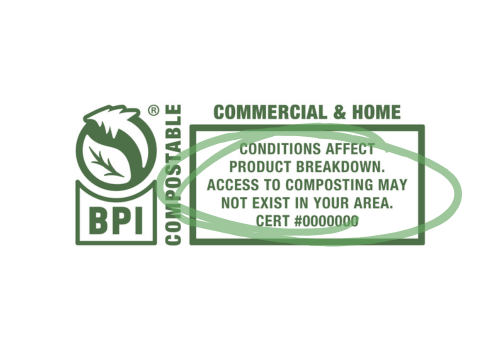
You may have noticed that the BPI Certification Mark always includes a short line of text—qualifier language—beneath it. This language is required and intentional.
It clarifies that the product is designed for commercial composting facilities, and that access to such facilities may vary by region. In other words, while the product is proven to break down safely under the right conditions, not every community currently has the composting infrastructure needed to process it.
This transparency helps manage expectations and prevent misinformation. The qualifier language ensures that certification remains both accurate and honest, reinforcing that compostable products must end up in the right system to deliver their environmental benefits.
It’s a small line of text—but one that upholds BPI’s commitment to clarity, accountability, and consumer education.
In Shakespeare’s world, names might not have changed the essence of a rose. But in our world of sustainability and circularity, marks matter deeply.
A certification mark isn’t about branding—it’s about truth. It tells composters that a product will perform. It tells consumers they can trust what they buy. And it tells policymakers that science, not slogans, is guiding our progress.
At BPI, our mark stands for more than compostability. It stands for credibility, collaboration, and circularity—a symbol of integrity in an era of greenwashing.
So the next time you see a product labeled “compostable,” ask yourself:
“What’s in a mark?”
Read more about greenwashing vs. the real deal here.


