Co-authored by Dr. Anthony Keyes, Senior Formulation Engineer for Natur-Tec (naturtec.com)
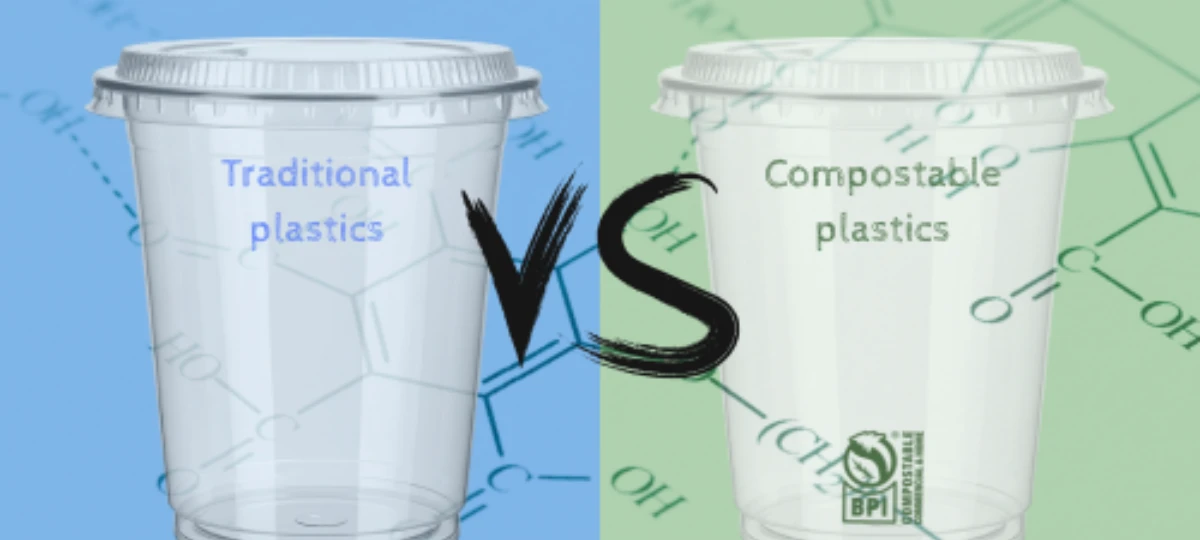
You might be wondering why one plastic item—say, a take-out container holding your Chipotle burrito bowl—can linger in the environment for decades, while another nearly identical, certified-compostable container can break down in compost when handled properly. If that question has crossed your mind, you’re in the right place.
In a recent BPI-hosted webinar, Dr. Anthony Keyes, a polymer scientist with Natur-Tec, explained why this happens and how compostable plastics are intentionally designed to behave differently at the molecular level.
Fair warning: a little chemistry is coming up—but don’t worry; you don’t need a lab coat or a science degree to follow along. Think of this as a behind-the-scenes look at how compostable plastics are designed to work with compost systems.
First, a quick chemistry callout:
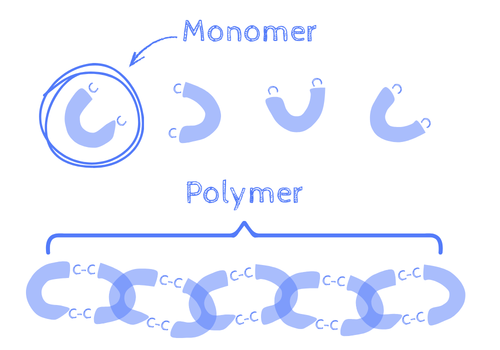
A polymer is a material made of long, repeating links of small building blocks called monomers.
Think of it like this:
Plastics are polymers. So are many natural materials you encounter every day—like cellulose in plants, proteins in food, and even DNA.
What makes polymers useful is that changing the type of “beads” (monomers) and how they’re linked together changes the material’s properties—whether it’s rigid or flexible, durable or compostable. That’s why some polymers are designed to last a long time, while others are designed to break down under the right conditions.
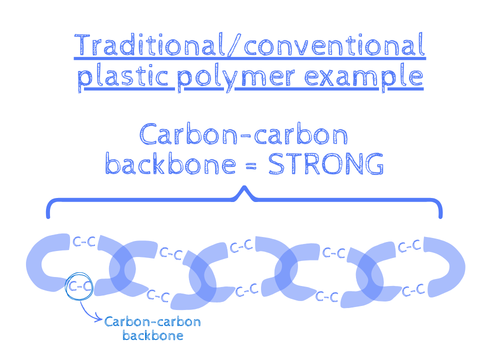
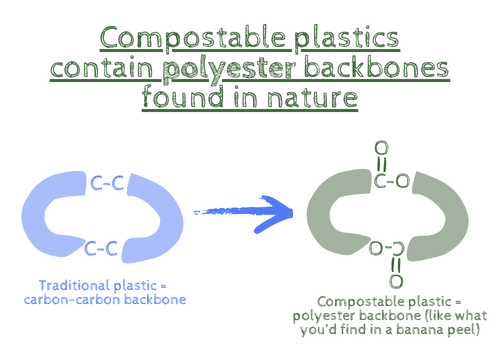
Traditional or conventional plastics like polyethylene (PE), polypropylene (PP), and polystyrene (PS) are built around strong carbon–carbon backbones. These bonds are extremely stable and resistant to heat, moisture, and microbial activity—the very conditions present in composting environments.
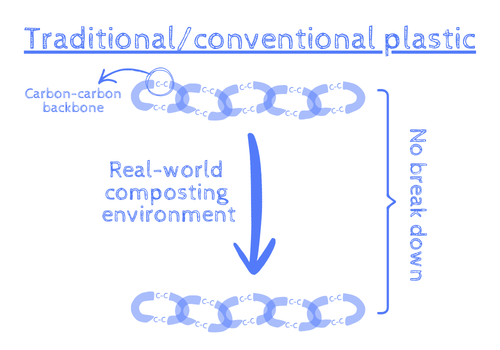
As a result, when conventional plastics enter a compost facility, they may crack or fragment into smaller pieces, but the underlying polymer structure remains intact—leading to persistent microplastics. The material does not fully break down or mineralize the way natural materials—like food scraps or plant fibers—do.
Compostable plastics take a fundamentally different approach. Rather than relying on carbon–carbon backbones, many compostable materials are polyesters—polymers linked together with ester bonds. A good example of a polyester in nature is cutin, the main polymer that makes up plant cuticles (protective layers in plants, like the waxy feeling on leaves). For compostable plastics, these bonds are strong enough for everyday use but are designed to come apart under industrial composting conditions.
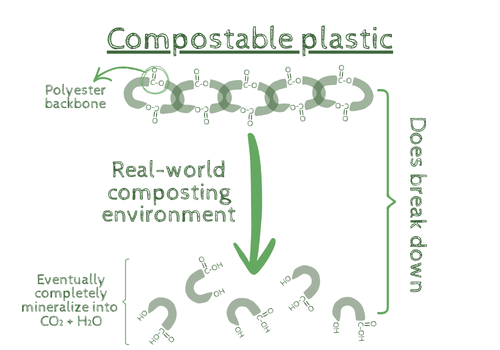
As heat, moisture, and microorganisms act on these materials, the polymer chains gradually break into smaller components that can be used as a food source by the microbes present. Over time, the materials fully mineralize into carbon dioxide and water, completing a biological cycle similar to natural organic matter. In other words, truly compostable plastics eventually turn back into fuel that can be utilized by microbes to help plants grow.
No single compostable polymer can meet every performance need, so manufacturers work with a toolbox of compostable polyesters. Polylactic acid (PLA) is one well-known example, often derived from plant-based feedstocks, but it’s just one tool in the kit.
Other compostable polyesters (like PHA and PBAT) are used to add flexibility, toughness, or tear resistance. What these materials share is their polyester chemistry, which allows them to break down in composting environments while still performing as functional products during use.
One of the biggest technical challenges is making compostable plastics behave like the conventional plastics they’re meant to replace. Consumers and foodservice operators expect forks to be sturdy, bags to resist tearing, and packaging to hold its shape.
To get there, scientists blend different compostable polymers to act as a foundation for the final product. Additional additives such as talc are commonly used for performance enhancement while non-toxic dyes and inks are incorporated for labeling and branding. By adjusting these blends, manufacturers can closely match the performance of familiar plastics with the added benefit of a compostable product.
Examples include:
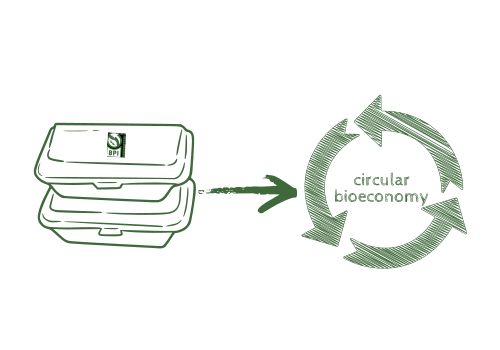
Traditional plastics are engineered for durability, not compostability—and composting environments can’t overcome the chemical hurdle of carbon-carbon backbones. Compostable plastics, by contrast, are designed with their end-of-life in mind. They’re made to be used alongside food scraps—helping collect and transport organic waste to compost bins—while taking notes from nature and utilizing polyester backbones chemistry. By using polyester-based polymers and carefully engineered blends, scientists are creating materials that meet performance expectations while still breaking down as intended in industrial composting systems, and more recently, well managed home composting systems. When chemistry employs end-of-life focused design and is verified by a third-party certifier, that is what truly sets certified compostable plastics on the path to helping make organic waste recycling in compost cleaner and safer, supporting the transition to the circular bioeconomy.
Click here to learn about how BPI Certification verifies a product’s compostability, and watch a series of videos with Dr. Anthony Keyes discussing how compostables are made below: